Mathew William Armitage Fok (quiksilver67213@yahoo.com)
Documentation structure:
This repository also includes
inst/scripts/techila/README.Rmd, which provides
Techila/distributed-run notes and execution guidance.
The root README.md is the canonical public-facing README
for users, CRAN, and external contributors.
DDESONN - Deep Dynamic Experimental Self-Organizing Neural Network - is an R-based research framework for adaptive neural network experimentation.
The project was initiated to build a fully custom neural network system that did not already exist, and to develop a deep, first-principles understanding of machine learning by necessity rather than by copying existing frameworks.
DDESONN blends self-organizing principles with modern deep-learning practices to support:
The primary design objective of DDESONN is to provide a fully customizable, entirely R-native neural network codebase and framework, intentionally avoiding external deep-learning backend library dependencies to preserve full architectural control and transparency.
DDESONN is a fully native R framework for constructing, training, evaluating, and inspecting Deep Dynamic Ensemble Self-Organizing Neural Networks.
The package is designed for users who need direct control over model architecture, optimization behavior, and training workflow details rather than black-box abstractions. It exposes both high-level helpers and inspectable low-level behavior for reproducible neural-network experimentation in R.
DDESONN is implemented entirely in R and does not rely on external deep-learning computational backends (e.g., TensorFlow, Torch, or compiled GPU runtimes). All forward propagation, backpropagation, optimizer state updates, and ensemble orchestration are handled directly within the R codebase.
This design choice ensures:
The framework is intentionally explicit rather than abstracted behind external engine calls.
DDESONN exists because I wanted to understand machine learning at a deeper level than “use a library and hope it works.”
Neural networks first fascinated me during an Advanced Time Series Analysis course (before the current wave of AI hype), where I began to appreciate the mathematical structure behind prediction, stability, and model evaluation, and I knew early that understanding these systems deeply—not just using them—would matter long-term. I also remember telling classmates in a business science course that I aspired to publish another package beyond OLR - Optimal Linear Regression, and that commitment quietly stayed with me, eventually evolving into what became DDESONN.
I didn’t want a neural network that was hidden behind abstractions. I wanted a neural network that people could actually look into layer by layer, error by error, update by update and see exactly what’s happening. Most modern frameworks make it easy to train a model, but they also make it easy to never truly understand what the model is doing internally.
So I built DDESONN to be inspectable, transparent, and architecturally explicit, and I intentionally avoided relying on external neural network or machine learning libraries. That wasn’t because I couldn’t use them. It was because I wanted to build the full machinery end-to-end and learn what “correct implementation” actually means.
This package took an extreme amount of time and emotional energy to build.
There were long stretches where I thought it was correct, but still didn’t fully trust it, and that uncertainty is hard because when you’re building the full architecture from scratch, bugs aren’t obvious. They can hide inside dimension handling, layer wiring, activation derivatives, error propagation, weight updates, and edge cases that only appear under certain random seeds or training paths.
I nearly gave up twice.
What kept me going was the belief that I was on the right track—even when the results didn’t always look right. In a strange way, life events kept pulling me back onto this path. Every time I stepped away, I came back with more clarity, and every time I came back, I pushed the implementation closer to what it should be.
As I went deeper, it honestly got scarier, because there were moments where DDESONN looked better than benchmark models, and other moments where it didn’t, and that inconsistency can mess with your head when you’ve invested everything into building it correctly.
An additional motivation along the way was to benchmark DDESONN against established deep-learning frameworks and push it toward competitive performance. Early on, I set an ambitious target around a 96.00% reference result, but I later realized that some comparison settings were not properly aligned, which forced me to revisit tuning assumptions, correct implementation details, and remove duplicated or misrouted update logic that had subtly distorted behavior. That effectively reset the target and turned the benchmark into a moving goalpost, because once the implementation was aligned correctly, the bar naturally shifted upward.
As performance improved into the high 99.8% range, the dynamic changed again, because at that level single-run comparisons stopped being meaningful and variance across random seeds began to dominate observed differences. What initially felt like a race toward peak accuracy evolved into a deeper investigation of stability, reproducibility, and distributional behavior across large seed sweeps, where mean performance, standard deviation, and worst-case outcomes mattered more than isolated best runs.
The turning point wasn’t one magic upgrade. It was the final phase of clearing out the subtle bugs and aligning the implementation to mathematically correct behavior, eliminating duplicate logic, tightening update flows, and ensuring evaluation consistency. Once those last structural issues were resolved, the model became dramatically more stable.
When I say “better,” I don’t mean one cherry-picked run.
I mean repeated evaluation across large numbers of randomized initializations (seeds). In my testing, once the final correctness issues were resolved, DDESONN produced results that were:
At that point, it stopped feeling like “maybe this works” and started feeling like “this is now a stable, correct implementation that competes.”
The broader acceleration of AI made this kind of from-scratch, fully inspectable work feel even more important - not as a trend to follow, but as a way to understand what these systems are actually doing.
DDESONN is built to show you what it’s doing.
Even in low-verbosity mode, it exposes the key structural diagnostics (layer dimensions, activation choices, error shapes, and sanity checks), and high-verbosity mode expands that into full step-by-step tracing when you’re debugging or studying behavior.
This is not just a model — it is an implementation we can learn from.
Artificial intelligence tools were used during development to support iteration speed, debugging, refactoring, and documentation drafting.
The primary tools used were ChatGPT and Codex (sparingly), with Copilot and Blackbox AI used on a more limited basis.
While AI tools accelerated iteration, the completion of this project required substantial sustained personal effort, discipline, and persistence.
DDESONN was designed with a flexible, research-oriented architecture that enables structured ensemble workflows, temporary-to-main model promotion, metric-driven refinement, customizable optimization strategies, and configurable activation behavior. The innovative ensemble methodology, experimental structure, validation logic, user-level customization depth, and final implementation authority remained under my direct authorship, review, and verification.
AI systems functioned as development accelerators and exploratory aids. All architectural design decisions ultimately reflect deliberate human direction and sustained independent effort.
DDESONN supports structured diagnostics designed to keep runs scientifically inspectable without overwhelming console noise.
CORE METRICS / Final Summary output is emitted as
part of the run summary path, independent of verbose,
verboseLow, and debug settings. This keeps key
end-of-run reporting consistent across executions.
DDESONN exposes two verbosity tiers via verboseLow and
verbose:
verboseLow = TRUE,
verbose = FALSE)
verbose = TRUE)
debug)debug = TRUE enables additional targeted debug
diagnostics, but in the public API it is intentionally hard-gated by
DDESONN_DEBUG=1 for safety. In practice, this means:
debug = TRUE and environment
variable DDESONN_DEBUG=1viewTables)viewTables = TRUE enables table-formatted output for
supported sectionsddesonn_viewTables() and requires
knitr for polished formattingThis design keeps low-verbosity runs practical, while still allowing deeper trace/debug modes when needed.
self_org) for
topology-oriented pre-adjustment during training.store_metadata()):
automatic recording of seeds, configuration, thresholds, metrics,
ensemble transitions, and model identifiers for reproducible, auditable
experimentation.ddesonn_model(...), ddesonn_fit(...), and
ddesonn_run(training_overrides = list(optimizer = ..., activation_functions = ...))).self_org)
through:
ddesonn_fit()ddesonn_run(training_overrides = ...)DDESONN supports structured dynamic ensemble orchestration built around a Primary (Main / Champion) Ensemble and one or more Temporary (Temp / Challenger) Ensembles.
All Champion vs Challenger promotions and prunes are recorded as structured run metadata so ensemble evolution is reproducible and fully auditable.
The workflow operates conceptually as:
This architecture allows controlled model competition under a chosen metric (e.g., loss, F1, AUC, or other user-selected evaluation criteria).
In practical terms:
This design mirrors a strict Champion vs Challenger structure while remaining fully metric-driven and reproducible.
Current vignettes demonstrate ensemble scenarios. A future vignette will provide a focused walkthrough of Champion vs Challenger promotion logic, metric-based pruning, and multi-iteration refinement.
main_log (Champion log): iteration-level snapshots of
the Champion ensemble state and metric valuesmovement_log (Champion/Challenger transitions):
deterministic promotion/replacement events (what moved, from/to, delta,
and why)change_log: iteration-level update diagnostics and
structural deltas for traceabilityclassification_mode = "binary",
"multiclass", and "regression".y
should be encoded as integer class indices 1..K (or a
one-hot matrix whose columns follow the model’s class order), otherwise
accuracy comparisons may be incorrect.writexlopenxlsxggplot2plotlyR/api.R for external
integration.DDESONN lets you define single-layer or deep multi-layer architectures with user-selected widths (no hardcoded depth limit in the public API flow).
For hidden_sizes, the current rules are:
architecture = "single": any supplied
hidden_sizes are ignored (with a warning).architecture = "multi": at least one
positive hidden size is required.For list/vector conformance elsewhere, DDESONN aligns by direct replicate/truncate logic:
L:
LNULLStructural conformance in this section is strictly replicate/truncate only. Values are copied or sliced to the required shape without additional transformation.
Architecture can also be set explicitly in user code, or auto-resolved by an API helper:
ddesonn_model)
ML_NN = FALSE.ML_NN = TRUE and provide
hidden_sizes (for example c(32, 16)).R/api.R)
normalize_architecture(architecture = "auto", hidden_sizes = ...)
resolves to single vs multi based on whether positive hidden sizes are
present.Minimal examples:
# explicit single-layer
m_single <- ddesonn_model(input_size = ncol(x), output_size = 1, ML_NN = FALSE, hidden_sizes = integer())

# explicit multi-layer
m_multi  <- ddesonn_model(input_size = ncol(x), output_size = 1, ML_NN = TRUE, hidden_sizes = c(32, 16))

# API helper auto-detect (internal helper in R/api.R)
normalize_architecture(architecture = "auto", hidden_sizes = integer(0))  # -> single
normalize_architecture(architecture = "auto", hidden_sizes = c(32, 16)) # -> multipredict(..., aggregate = ...) applies when a DDESONN
object contains multiple ensemble members. In that case, each model
produces a prediction matrix, and the aggregation rule combines those
per-model outputs into one final prediction matrix.
Conceptually, this follows standard ensemble learning practice: combine outputs from multiple learners into a single decision surface for downstream use.
Common usage patterns:
n x 1 or
n x d numeric outputs):
"mean": combines model outputs element-wise
using the arithmetic mean."median": combines model outputs
element-wise using the median, often useful for robustness to outlier
models.n x 1
probabilities):
n x 1.n x K
class-probability matrices):
K
columns, preserving shape n x K.Expected shape behavior:
M models and each returns shape
n x K, aggregation consumes M matrices and
returns one n x K matrix.aggregate = "none", the workflow uses a single
member output directly (no cross-model combining).Reachability in this repository:
R/api.R): grouped metrics
are reachable via training configuration (grouped_metrics)
that is passed through
ddesonn_fit()/ddesonn_run() into the model
training call.inst/scripts/TestDDESONN.R): grouped metrics are
also directly toggled in the script workflow via
grouped_metrics <- ....Grouped metrics are summary metrics computed across a set of models or runs, rather than from a single model only. They are useful when you want segmented evaluation views across experiment dimensions (for example, by run, seed, ensemble role, or model subset) to understand stability and behavior under variation.
In practice, grouped metrics support questions such as:
Example usage scenarios:
n x 1 (binary) or n x K
(multiclass).M model prediction vectors (n x 1)
on the same test set.n x 1) and
grouped error summaries to compare combined output quality versus
per-model performance.Grouped metrics and high/low performance relevance boxplots are complementary, but they are not generated from the same source objects.
Because they are computed through different paths, values are not expected to match one-to-one. A practical workflow is to use grouped metrics for comparative selection/monitoring, then use high/low relevance boxplots for visual distribution diagnostics on the selected groups.
While high-level workflows are provided through
ddesonn_run(), ddesonn_model(), and
ddesonn_fit(), the project also includes an experimentation
script located at:
inst/scripts/TestDDESONN.R
This script reflects the original development workflow and provides direct, low-level control over the training pipeline, including:
In this context, nearly every component of the training process can be explicitly tuned and inspected.
The current public API exposes structured configuration for most common use cases. Future releases may expand first-class API hooks to make advanced customization more directly accessible through the public interface.
Learning-rate scheduling observations
During experimentation, learning-rate scheduling did not consistently improve binary-classification performance and in several tests slightly reduced accuracy relative to fixed learning-rate runs.
However, the same scheduling logic appeared more beneficial in regression settings, where gradual step-down learning rates improved training stability and convergence behavior.
As a result, learning-rate scheduling should be considered experiment-dependent rather than universally beneficial.
Core implementation is modular and intentionally explicit:
R/DDESONN.R
Central R6 class implementing SONN core logic, training, prediction, and
orchestration
R/activation_functions.R
Activation function library (ReLU, sigmoid, bent, and others)
R/optimizers.R
Optimizer implementations and optimizer state handling
R/update_weights_block.R
Weight update routines with optimizer routing
R/update_biases_block.R
Bias update routines kept separate from weight logic
R/performance_relevance_metrics.R
Accuracy, precision, recall, F1, and relevance metrics
R/utils.R
Shared helper utilities
R/api.R
High-level API-style wrapper for simplified consumption
R/evaluate_predictions_report.R
Excel and plot-based evaluation reporting
Formal R vignettes for guided exploration and reproducible demonstrations are available in the vignettes directory.
Techila (distributed/parallel compute) support exists to scale
heavier experiments across multiple servers/workers.
Use it optionally by guarding calls, for example:
if (requireNamespace("techila", quietly = TRUE)) { ... } else { ... }.
This becomes relevant quickly when you start running large seed sweeps
(e.g., hundreds to thousands of seeds across hundreds of epochs).
DDESONN began as an exploratory research project and progressed through several architectural checkpoints as core ideas were validated and refined.
Subsequent iterations focused on formalizing the architecture, improving reproducibility, and restructuring the codebase to meet CRAN packaging standards.
2024-05-07 — Project origin
The project formally began as a personal research initiative to design
and implement a novel self-organizing neural network framework in R,
prioritizing explicit training logic, architectural transparency, and
experimental flexibility.
2024-05 to 2024-08 — Initial intensive development phase (4
months)
Sustained day-in/day-out development. Machine learning concepts were
studied from first principles in order to design the architecture
manually, reason through dimensional flow, identify bottlenecks, and
resolve deep implementation issues.
2024-09 to 2025-06 — Development pause (10 months)
Active development slowed significantly during this period due to
full-time professional commitments.
2025-06 to 2025-08 — Iterative refinement and hardening phase (3
months)
Work resumed with renewed focus on correctness, optimizer stability,
ensemble reliability, and reproducibility. Significant bug-clearing and
mathematical alignment improvements were completed during this
period.
2025-09 to 2025-10 — Transitional development and benchmark
breakthrough (2 months)
A key multi-seed stability breakthrough was achieved during this period.
This led to the creation of the comparative benchmark vignette
DDESONNvKeras_1000Seeds.Rmd, formally documenting
1,000-seed reproducibility experiments and cross-framework evaluation
against Keras. Work during this phase focused on validation rigor,
controlled seed sweeps, and structured reproducibility
reporting.
2025-11 to 2025-12 — Reduced development activity (2
months)
Development intensity decreased substantially as two new parallel
projects required priority. Work during this period was
limited.
2026-01 to 2026-02 — Final packaging, vignette expansion, and
CRAN preparation phase (2 months)
Focus shifted to converting the research framework into a structured,
turnkey R package suitable for CRAN distribution. This included API
stabilization, documentation alignment, artifact-path standardization,
reproducibility controls, and the creation of formal vignettes for
guided exploration.
Additional vignettes are planned to further expand structured
demonstrations and ensemble deep-dive documentation.
Earlier checkpoint versions and legacy research code may be published separately in a dedicated archival repository to document the project’s evolution, including early snapshots where certain components were not fully retained.
DDESONN/
├── R/
├── man/
├── vignettes/
│   ├── DDESONNvsKeras_1000Seeds.Rmd
│   ├── logs_main-change-movement_ensemble_runs_scenarioD.Rmd
│   ├── plot-contols_scenario1_ensemble-runs_scenarioC-D.Rmd
│   └── plot-controls_scenario1-2_single-run_scenarioA.Rmd
│
├── inst/
│   ├── extdata/
│   │   ├── heart_failure_clinical_records.csv
│   │   ├── train_multiclass_customer_segmentation.csv
│   │   ├── test_multiclass_customer_segmentation.csv
│   │   ├── WMT_1970-10-01_2025-03-15.csv
│   │   └── heart_failure_runs/
│   │       ├── run1/
│   │       └── run2/
│   │
│   └── scripts/
│       ├── DDESONN_mtcars_A-D_examples.R
│       ├── DDESONN_mtcars_A-D_examples_regression.R
│       ├── Heart_failure_ScenarioA.R
│       ├── LoadandPredict.R
│       ├── TestDDESONN.R
│       ├── vsKeras/
│       │   └── 1000SEEDSRESULTSvsKeras/
│       └── techila/
│           ├── README.Rmd
│           ├── single_runner_local_mvp.R
│           └── single_runner_techila_mvp.R
│
├── DESCRIPTION
├── NAMESPACE
├── README.md
├── LICENSE
└── LICENSE.mdBash:
git clone https://github.com/MatHatter/DDESONN.git
cd DDESONN
Install the development version directly from GitHub (optional):
remotes::install_github("MatHatter/DDESONN")Inside R:
required_pkgs <- c(
  "R6","cluster","fpc","tibble","dplyr","tidyverse","ggplot2","plotly",
  "gridExtra","rlist","writexl","readxl","tidyr","purrr","pracma",
  "openxlsx","pROC","ggplotify"
)

missing <- setdiff(required_pkgs, rownames(installed.packages()))
if (length(missing)) install.packages(missing)
invisible(lapply(required_pkgs, library, character.only = TRUE))
To load for development (dev-only):
devtools::load_all()For installed packages:
library(DDESONN)Note: source() is development-only and not recommended
for installed packages.
Epoch selection
The optimal number of epochs is experiment-dependent and may vary significantly across datasets, architectures, and seeds.
In practice, num_epochs should be treated as a tunable
upper bound rather than a fixed universal value. The objective is to
identify a suitable stopping point for each model configuration rather
than rely on a single epoch count across experiments.
High-level API usage (training split is always
x/y):
res <- ddesonn_run(
  x = train_x,
  y = train_y,
  validation = list(x = valid_x, y = valid_y),
  test = list(x = test_x, y = test_y),
  training_overrides = list(
    num_epochs = 1,
    validation_metrics = TRUE,
    self_org = FALSE  # set TRUE to enable self-organization
  )
)
Many experiments in this repository use num_epochs = 360
for the heart-failure dataset used in the benchmark vignettes. This
value was empirically suitable for that dataset but should not be
interpreted as a recommended universal setting.
If ddesonn_run() already works for you, you’re not doing
anything wrong. It is the “all-in-one” orchestrator and is the best
default for most users.
Use this quick guide:
ddesonn_run(): one-call workflow for
train/validation/test orchestration, seed loops, optional ensemble
scenarios, and summary outputs. Best for experiments and benchmark
runs.ddesonn_model(): construct a model
object only (architecture/setup stage). Use when you want explicit
control before training.ddesonn_fit(): train an
already-created model. Use when you want a custom loop, staged training,
or fine-grained control over train calls.predict() /
predict.ddesonn_model(): user-facing inference on
new data after training.ddesonn_predict(): internal low-level
prediction engine. Useful for package internals and advanced users, but
most users should prefer predict().ddesonn_training_defaults(): inspect
the baseline training parameters used by wrappers.ddesonn_activation_defaults() /
ddesonn_dropout_defaults() /
ddesonn_optimizer_options(): helper utilities to
inspect or build settings.In short: think of ddesonn_run() as the convenient
“driver”, while the other functions are modular building blocks that
make the driver customizable, testable, and reusable in advanced
workflows.
Typical progression:
ddesonn_run().ddesonn_model() + ddesonn_fit()
when you need custom training flow.predict() for downstream inference and
reporting.Self-organization toggle (public API):
ddesonn_fit(), pass self_org = TRUE (or
FALSE) directly.ddesonn_run(), pass
training_overrides = list(self_org = TRUE) (or
FALSE).self_org = FALSE) unless you explicitly
enable it.self_organize() is an unsupervised topology-adjustment
phase that updates the network using input-space
neighborhood/organization error rather than prediction-target residual
error. In other words, it optimizes topographical structure of the
representation (input manifold organization), not the direct supervised
prediction-loss objective.
In exploratory experiments, enabling it may have positive implications for topographical-analysis accuracy on some datasets/workflows, so it is useful to benchmark both settings.
Evaluation plot toggles (ROC/PR/accuracy) can be enabled via
training_overrides. The PR curve includes AUPRC by default;
set show_auprc = FALSE to suppress:
res <- ddesonn_run(
  x = train_x,
  y = train_y,
  classification_mode = "binary",
  seeds = 1,
  validation = list(x = valid_x, y = valid_y),
  test = list(x = test_x, y = test_y),
  training_overrides = list(
    validation_metrics = TRUE,
    evaluate_predictions_report_plots = list(
      roc_curve = TRUE,
      pr_curve = TRUE,
      accuracy_plot = TRUE,
      accuracy_plot_mode = "both",
      show_auprc = TRUE
    )
  )
)Bottom line: ddesonn_predict() = internal
prediction engine (raw forward pass / ensemble aggregation; used
internally in training/validation and internal evaluation
paths). predict.ddesonn_model() /
predict() = public, canonical user-facing API that wraps
ddesonn_predict() and standardizes arguments + output shape
+ optional thresholding.
Why: internal code uses ddesonn_predict() because it’s a
forward-pass primitive that’s faster and easier to control inside
training loops (no user-facing return formatting). User-facing inference
should use predict() because it provides a stable contract
(type/aggregate/threshold handling, return structure).
Multiclass note: For multiclass classification, y should be encoded as integer class indices 1..K (or a one-hot matrix whose columns follow the model’s class order), otherwise accuracy comparisons may be incorrect.
When test = list(x = test_x, y = test_y) is provided,
the final run summary always includes test loss and test accuracy
computed once after training completes, and the values are available at
res$test_metrics$loss and
res$test_metrics$accuracy. If you want to independently
reproduce test accuracy, call
predict(res$model, test_x)$predicted_output, apply the same
threshold printed in the final summary, and compare element-wise to
test_y
(mean(as.integer(pred >= thr) == test_y)), which should
match the reported test accuracy when thresholds, aggregation, and
preprocessing are identical.
API design notes (optional explicit splits):
x_valid/y_valid and
x_test/y_test override the list inputs.x_valid without
y_valid).res$history mirrors the training metadata
(including best train/validation losses) and, when a test split is
supplied, adds test_loss alongside
result$test_metrics.Training and validation run inside ddesonn_run() and
call the model’s R6 methods directly.
Evaluation contract (test data):
test$x/test$y (or
x_test/y_test) are supplied,
ddesonn_run() is the authoritative source for test
loss and test accuracy. These metrics are computed once after
training completes, are stored at res$test_metrics$loss and
res$test_metrics$accuracy, and are returned/printed as part
of the final run summary.predict(res$model, x_test) and compute accuracy as
(number of correct predictions - total rows) via an
element-wise comparison against y_test using the same
threshold shown in the final summary (and the same aggregation and
preprocessing).ddesonn_run() test accuracy. Any mismatch indicates a
threshold or data-handling difference (not a model inconsistency).ddesonn_run() is for evaluation, while
predict() is for inspection, custom metrics, and
downstream logic - neither replaces the other.ddesonn_run() does not return per-row
predictions; per-row outputs are provided by predict()
only.After training completes, the returned model (res$model)
supports standard R workflows via predict(model, newdata).
This is enabled by a lightweight S3 adapter that forwards
predict() calls to the underlying R6
$predict() method.
Training behavior and final summary output are unchanged; this only standardizes post-training usage.
Notes on aggregation + split reports:
ddesonn_predict(..., aggregate = ...) output for each
split; no new aggregation behavior is added.Single vs Ensemble:
do_ensemble = FALSE,
num_networks = 1).do_ensemble = FALSE,
num_networks > 1L).do_ensemble = TRUE,
num_temp_iterations = 0).do_ensemble = TRUE,
num_temp_iterations > 0).Important distinction:
length(seeds) > 1L does not by
itself mean “runs” in this terminology block.num_networks > 1L) and ensemble iteration structure,
not to seed count alone.Scenario-family note:
do_ensemble, num_networks,
num_temp_iterations).plot_controls umbrella
call.What this repository already reflects:
Ready-to-run demos are available under inst/scripts:
Run directly:
source("inst/scripts/DDESONN_mtcars_example.R")Artifacts and plots are written under a user-writable data directory resolved by ddesonn_artifacts_root() (with plots under ddesonn_plots_dir()), preserving the same subfolder layout used previously under artifacts/.
Bundled sample data in inst/extdata/:
Current multiclass usage is demonstrated in
inst/scripts/TestDDESONN.R. Standalone CRAN-friendly
multiclass example scripts/vignettes are welcome via PR.
DDESONN includes a run-level metadata store that persists the
critical inputs and outputs needed to compare, trace, and reproduce
experiments across iterations and environments. This metadata is
recorded automatically during training via the core engine
(R/DDESONN.R) and captures seeds, configuration, training
flags, selected metrics, thresholds used, and per-model identifiers so
results are auditable rather than dependent on console output.
In addition to artifact path controls, this metadata store retains structured fields such as model serial IDs, ensemble iteration context, activation/dropout settings, best-epoch summaries, and the resolved performance/relevance metric selections used during evaluation and selection.
DDESONN supports reproducible experimentation through:
set.seed(...) and
seeds = ... in ddesonn_run())ddesonn_training_defaults()inst/scripts/ddesonn_artifacts_root(output_root = ...)Sys.getenv("DDESONN_ARTIFACTS_ROOT")options(DDESONN_OUTPUT_ROOT = ...)ddesonn_plots_dir()ddesonn_debug_state()These controls allow experiments to be rerun deterministically, inspected at multiple verbosity levels, and reproduced across systems without hidden state.
DDESONN run artifacts commonly include RDS outputs for train/validation and test metrics. Depending on mode, per-seed test representation is built differently:
is_ens = TRUE)
RUN_DIR/fused/ matching
fused_run*_seed*_*.rds.metrics table, parses
seed and run_index from the filename, then
filters one fusion strategy as the canonical test view (default:
Ensemble_wavg; alternatives may include
Ensemble_avg, Ensemble_vote_soft,
Ensemble_vote_hard).test_acc,
test_precision, test_recall, and
test_f1 before joining to train/validation summaries.is_ens = FALSE)
SingleRun_Test_Metrics_*_seeds_*.rds file.seed/SEED) and
metric columns (including f1_score -> f1),
then keeps one row per seed (highest accuracy) for the final merged
table.In both modes, merged per-seed summaries are produced by combining train/validation seed-level metrics with the mode-appropriate test representation.
SingleRun_Pretty_Test_Metrics_*_seeds_*.rds files are
intended as readable/inspection-oriented outputs (for example, predicted
labels/probabilities aligned with outcome y and predictor
context) rather than as the canonical source used for the numeric
per-seed summary merge above.
Reference helper scripts and related workflows currently include:
inst/extdata/vsKeras/TablesPerSeedMostRecentRunResults.Rinst/extdata/vsKeras/1000SEEDSRESULTSvsKeras/DDESONNproof.Rinst/scripts/LoadandPredict.RR/predict.RClarification on terminology: the per-seed fused rows
Ensemble_avg, Ensemble_wavg,
Ensemble_vote_soft, Ensemble_vote_hard are
ensemble-style fused prediction outputs computed from
model predictions for reporting/selection at the seed level. They are
not, by themselves, the full training/orchestration process that builds
and evolves ensembles; the Champion/Challenger promotion and pruning
flow is handled in the run pipeline.
Availability note: the compact/package-friendly snapshot may not
include every large vsKeras artifact (especially
DDESONNproof.R and related full benchmark outputs) to save
space. Full artifacts are available from the GitHub release/tag bundle
v7.1.7. ### Vignettes
Start with these vignettes in vignettes/:
plot-controls_scenario1-2_single-run_scenarioA.Rmdplot-contols_scenario1_ensemble-runs_scenarioC-D.Rmdlogs_main-change-movement_ensemble_runs_scenarioD.RmdDDESONNvsKeras_1000Seeds.RmdNaming clarification: in these vignette filenames, “Scenario 1/2” indicates plot-control style only, while “Scenario A/B/C/D” indicates run orchestration family. Refer to section: Run terminology.
These cover:
DDESONN includes precomputed .rds files under:
inst/extdata/
These files contain saved model outputs, metrics, and summaries used
specifically for the DDESONNvsKeras_1000Seeds.Rmd vignette
to:
These artifacts are:
They are provided solely to support reproducibility and documentation.
Note on scope and intent
The items below describe current behavior, explicit design intent, and
forward-looking considerations.
They are documented to clarify direction and preserve future ideas.
They do not imply active development or any committed delivery timeline.
Status: Forward-looking consideration
A future maintenance pass may perform light, non-breaking cleanup in
shared utilities (especially R/utils.R), including removing
legacy safety helpers that are no longer referenced, tightening
comments, and reducing incidental duplication. This work would be scoped
to readability and maintainability only, with no behavioral changes
intended.
Status: Design intent (future)
Related To-Do: T-01
Add structured hyperparameter grid and sweep utilities to support controlled, reproducible experimentation across model configurations.
Status: Design intent (future)
Related To-Do: T-02
Introduce optional preprocessing helpers, including:
log1p transforms for heavy-tailed
featurescreatinine_phosphokinase)Status: Current behavior (documented)
Related To-Do: T-03
The evaluation pipeline follows a strict and intentional thresholding contract:
evaluate_predictions_report.R selects and applies a
tuned threshold (best_thr) when generating thresholded
predictions.DDESONN.R records a single authoritative threshold
value (thr_used), which may be either the tuned threshold
or a user-provided override.thr_used (not a fixed 0.5 default).Status: Forward-looking consideration
Related To-Do: T-04
Potential future diagnostic capability to track training and validation metrics across epochs for a single model run.
Design constraints:
ddesonn_artifacts_root()ddesonn_plots_dir(){artifacts_root}/plots/single_run_per_epoch/process_performance() and all
ensemble summariesStatus: Forward-looking consideration
Related To-Do: T-05
In single-run mode, ensemble orchestration is disabled, but ensemble
slot objects (e.g., ensemble[[k]]) and metadata contracts
remain in use.
Decoupling this behavior would require a non-trivial architectural refactor and is documented here for clarity and future consideration.
validation_metrics scope and stabilization checkpointStatus: Current behavior (documented) +
forward-looking consideration
Related To-Do: T-06, T-07
validation_metrics gates the validation-only evaluation
report pipeline, including plots, confusion-matrix-derived metrics,
artifact exports, and tuned-threshold handling. Despite its name, it
does not represent generic metric computation.
Stabilization decision (v1):
validation_metrics is retained as a v1 stabilization
switch controlling whether validation-based evaluation and reporting are
executed.Design intent (future):
validation_metrics semantics with explicitness
(e.g., tri-state control: off | validation | train) only
after the tuning logic is modularized.viewTables table-emission standardizationStatus: Partially implemented (v1) + scoped forward-looking refinement Related To-Do: T-08
viewTables is now supported as an explicit, per-run
handler and is routed through a centralized table-emission helper
(ddesonn_viewTables()).
As of the current implementation: - viewTables can be
passed explicitly to ddesonn_run() /
ddesonn_fit(). - Table-like outputs from: - final run
summaries - Core Metrics: Final Summary: binary classification reports
(classification report + confusion matrix) - evaluation reports
(EvaluatePredictionsReport) - model selection helpers (e.g.,
find_best_model()) - aggregation / fusion debug previews - selected
prediction-evaluation debug paths are routed through
ddesonn_viewTables() - A legacy fallback lookup (get0(“viewTables”,
inherits = TRUE)) is preserved for backward compatibility when no
explicit handler is supplied - A run-level warning guard prevents
repeated warnings when invalid handlers are passed
This establishes a top-level, consistent table-display contract for the most visible and user-facing reporting paths, without breaking existing workflows.
Remaining work (documented, not urgent) involves auditing low-visibility or rarely executed debug paths to ensure all table-like emissions route through the same helper.
Status: Forward-looking consideration
Related To-Do: T-09
The project already includes a major comparative vignette:
vignettes/DDESONNvsKeras_1000Seeds.Rmd (Heart Failure,
1000-seed summary).
Future releases may expand the vignette suite (more datasets, more experiments, more reproducible walkthroughs) and optionally explore interactive diagnostics (e.g., Shiny) as a non-core layer.
Status: Forward-looking consideration
Related To-Do: T-10
Techila exists to scale heavy experiments across multiple servers/workers for seed sweeps and larger runs. This is particularly valuable when you want hundreds to thousands of seeds without waiting on a single machine.
Status: Forward-looking consideration
Future releases may explore reference implementations of the DDESONN architecture in other programming languages (e.g., Python, MATLAB, C#, C++).
The goal would not be to wrap existing deep-learning libraries, but to preserve the same architectural transparency and explicit training logic across languages.
Status: Planned documentation expansion
A dedicated vignette will formally document:
This will provide a structured walkthrough of ensemble evolution
mechanics currently demonstrated in TestDDESONN.R and
related scripts.
Status: Forward-looking consideration
Related To-Do: T-12
Structural conformance is currently limited to replicate/truncate alignment. Refer to subsection: Dimension-agnostic behavior (exactly how it works).
Future iterations may explore alternative alignment strategies (e.g., averaging, weighted aggregation, or other reconciliation mechanisms), if empirical evaluation supports their inclusion.
The current implementation intentionally avoids transformation during shape alignment to preserve deterministic and explicit structural behavior.
Status: Forward-looking concept
Future versions may include a visualization utility capable of generating neural-network artwork where equations, constants, and hyperparameters from the DDESONN engine (e.g., learning rate, hidden sizes, activation functions, optimizer parameters) are embedded along network pathways and synaptic structures.
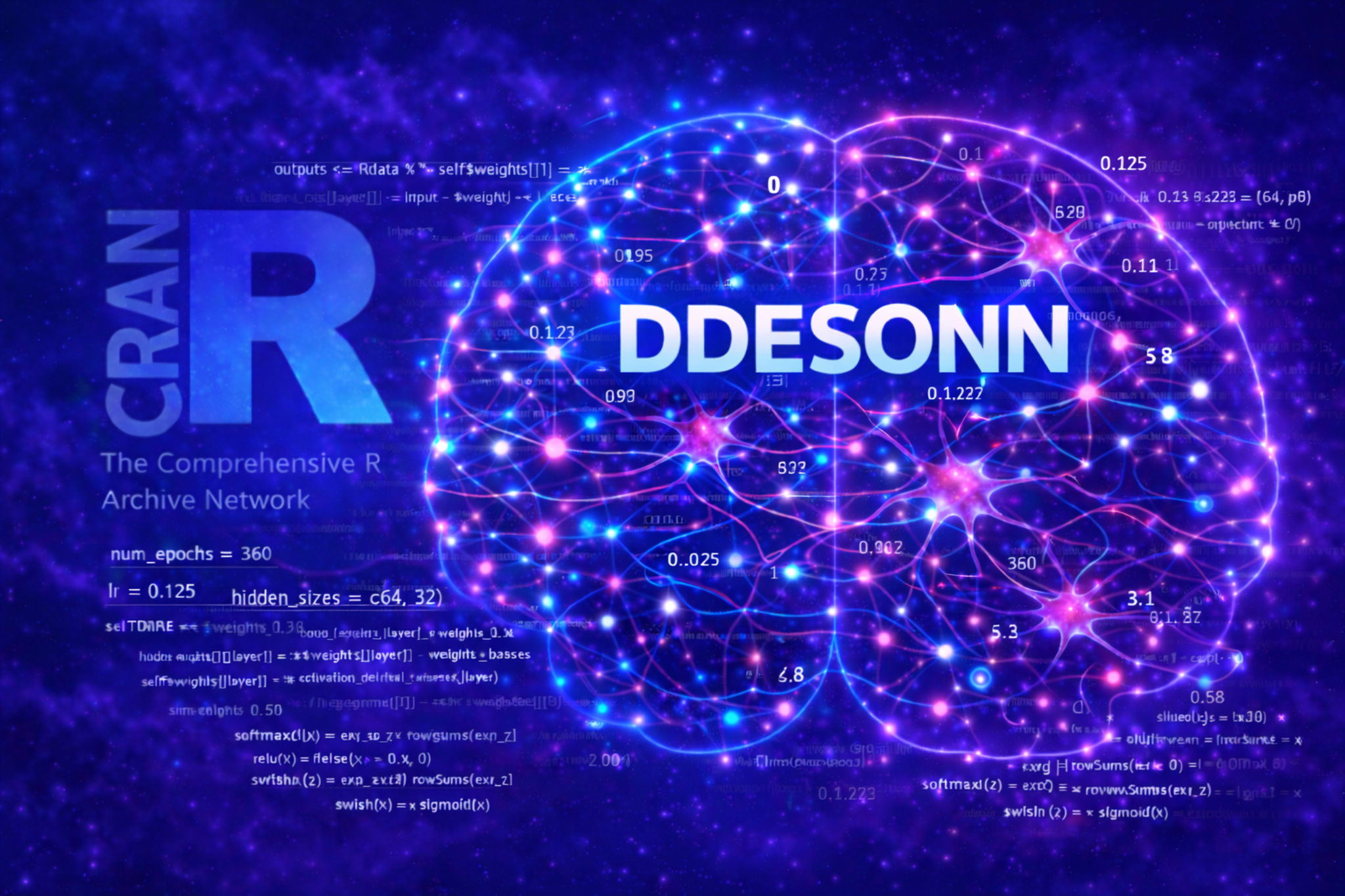
The visual output would intentionally follow the same aesthetic style as the DDESONN neural-network brain artwork shown at the top of the README, keeping equations and numbers integrated along synaptic paths rather than placed randomly around the network.
Linked from: R-01
Implement structured grid and sweep tooling with explicit configuration, clear artifacts, and reproducibility guarantees.
Linked from: R-02
Define a clean, opt-in preprocessing interface without implicit transformations or side effects.
Linked from: R-03
best_thr selection remains localized to
evaluate_predictions_report.Rthr_used is the single source of truth in
summaries and metadatathr_usedLinked from: R-04
Prototype per-epoch metric capture for single runs only, with no impact on ensemble aggregation or performance summaries.
Linked from: R-05
Assess architectural implications of separating single-run execution from ensemble metadata and orchestration contracts.
validation_metrics contract clarification (post-v1)Linked from: R-06
validation_metrics enables/returns
(evaluation report pipeline + artifacts + tuned-threshold support)Linked from: R-06
chosen_threshold) while keeping reporting
optionaloff | validation | train (or separate
evaluation_report + evaluation_data)viewTables coverage audit and completion passLinked from: R-07
Perform a repository-wide audit for remaining direct
print(), View(), head(), or
table-rendering calls on data frames/tibbles in reporting, evaluation,
or debug paths
Route any remaining table-like output through
ddesonn_viewTables() or emit_table() (which
delegates to it)
Confirm viewTables behavior is consistent
across:
Keep changes minimal and non-breaking; this task is strictly a coverage and consistency sweep, not a redesign
Linked from: R-08
DDESONNvsKeras_1000Seeds.Rmd)Linked from: R-09
Linked from: R-10
Evaluate architectural portability and determine minimal core components required for a language-agnostic implementation.
Linked from: R-12
Contributions are welcome and appreciated. For bugs, feature requests, and collaboration discussion, please use the GitHub issues page: https://github.com/MatHatter/DDESONN/issues.
main.If your pull request introduces behavioral changes, architectural adjustments, or new functionality, please include:
This ensures that changes remain scientifically traceable and consistent with the design philosophy of DDESONN.
Techila support is available for distributed experimentation and large-scale seed sweeps. As distributed environments can vary significantly, contributions and validation feedback related to Techila integration are especially welcome.
Contributions are particularly appreciated in areas such as:
If you are interested in helping move the project toward a cleaner and more stable plateau, the Roadmap & To-Do sections are the best place to identify meaningful contribution opportunities.
DDESONN is released for personal, educational, and research use
only.
Commercial use requires written authorization.
The author also maintains additional modeling projects in R and Python, including:
If you found DDESONN useful, interesting, or thought-provoking, feel free to connect with me on LinkedIn.
If you send a connection request, please include a short note mentioning DDESONN so I know where you found it. I read those messages.
Questions about the architecture, implementation details, or research design are welcome. I’m happy to respond when I can.
Mathew William Armitage Fok
