



Causal Graph Interface (for R) — a fast and flexible toolbox for building, coercing and analyzing causal graphs.
caugi?caugi (pronounced “corgi”) stands for Causal
Graph Interface. It is a causality-first graph package
that focuses on performance and flexibility. If you are developing
scripts or algorithms in the field of causality or if you are learning
about causal graphs for the first time, caugi is made for
you.
You can install the development version of caugi from
GitHub with:
pak::pak("frederikfabriciusbjerre/caugi")or directly from CRAN with:
install.packages("caugi")Rust is required for caugi to work. If you don’t have
Rust installed, visit rustup.rs for
installation instructions appropriate for your platform.
Alternatively, you may install Rust from your OS package manager.
caugiA caugi graph object is the bread and butter of the
caugi package. It is easy to create, query, and modify.
library(caugi)You can create simple graphs as well as a number of predefined graph
classes. Currently, we support "UNKNOWN",
"DAG", "PDAG", "MPDAG",
"CPGAG", "ADMG", "AG", and
"UG". We plan on supporting several other causal graph
types in future releases, such as "PAG",
"MAG", and "SWIG".
# a tiny DAG
cg <- caugi(
  A %-->% B + C,
  B %-->% D,
  C %-->% D,
  class = "DAG"
)

plot(cg)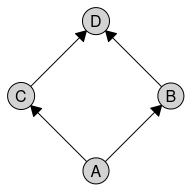
The available edges in caugi are listed below:
%-->% (directed)%---% (undirected)%<->% (bidirected)%o->% (partially directed)%--o% (partially undirected)%o-o% (partial)You can register more types with register_caugi_edge(),
if you find that you need a more expressive set of edges. For example,
if you want to represent a directed edge in the reverse direction, you
can do so like this:
register_caugi_edge(
  glyph = "<--",
  tail_mark = "arrow",
  head_mark = "tail",
  class = "directed",
  symmetric = FALSE
)

caugi(A %-->% B, B %<--% C, class = "DAG")
#> <caugi object; 3 nodes, 2 edges; simple: TRUE; session=0x7adebc2b0>
#>   graph_class: DAG
#>   nodes: A, B, C
#>   edges: A-->B, B<--C

# reset the registry to default with original edges
reset_caugi_registry()
We expect this feature to be needing further polishing in future releases, and we would love your input if you use this feature!
caugi provides a number of functions to query and
analyze caugi objects. Some of the available functions
are:
caugi graphs are represented in a compact Compressed
Sparse Row (CSR) format in Rust. caugi works with a
front-loading philosophy. Since the caugi graph is stored
in a CSR format, mutations of the graph is computationally expensive
compared to other graph storage systems, but it allows for very
fast querying. Additionally to the storage format of the graph itself,
caugi also stores additional information about node
relations in such a way that it allows for faster queries without
blowing up the object too much.
To accommodate for the cost of mutations, caugi graphs
are built lazily, but you can force a build by using the function
build().
It’s fast, dawg 🐶 See the article on performance on our website for benchmarks.
Would you like to contribute? Great! Please see Contributing to caugi for
detailed guidelines on code style, testing, and the development
workflow. Quick tips: follow the tidyverse style guide for R code, run
styler::style_pkg() for R and cargo fmt for
Rust before PRs, and write tests for new features.
Did you find run into problems? That’s paw-ful! Please report an issue!