


Local models. Inspectable experiments. Ordinary R.
relm runs open-weight models on your machine with no Python, model server or API key. Generate text and constrained JSON, embed documents, and inspect a model’s internal values using ordinary R vectors, data frames and matrices. Its Rust core embeds a pinned, patched llama.cpp; R remains your working environment for statistics, visualization and reproducible research.
Version 0.4.0 adds the complete research workflow:
background generation, token events, live observations, recorded
directions, component projections and base-R graphics, with code and
trace-validation maintenance. See the release
notes. The 0.4.0
release is published, including a verified fresh Mac arm64
r-universe installation. Check packageVersion("relm") and
restart R after upgrading.
The 0.5.0 source has been submitted to CRAN,
combining optional Linux CUDA and source portability. CRAN acceptance is
pending; see the submission
status. The 0.6.0 release, published on r-universe, adds optional
threads and exact modern chat templates. See model
configuration and measured limits and the published
release scope. Windows ARM64 and webR/WebAssembly are deferred and
are not current support or release targets. Ordinary PR checks focus on
Linux, macOS and Windows x86_64; the
CI scope retains the experimental work for future use. Python is
used only by maintainer reference/security tests; the R package does not
require a Python environment.
The 0.6.1 sources contain Python maintainer-tooling security updates,
the shared extendr R lookup correction and desktop build fixes. Check
the version available on r-universe and
packageVersion("relm") after installing. The published
0.6.0 tag and archive remain unchanged. Windows ARM64 and WebAssembly
stay deferred.
Use r-universe and check the builds available for your OS, R version and architecture:
install.packages(
  "relm",
  repos = c("https://vadale.r-universe.dev", getOption("repos"))
)
packageVersion("relm")
r-universe tracks main; check the version before using
the 0.4.0 research features. Prebuilt binaries need no native toolchain.
Source installation needs R >= 4.5, Cargo >= 1.85.0 and rustc
>= 1.85.0 (checked separately), CMake >= 3.28, xz and
a C/C++ compiler. See the installation
guide for source builds and troubleshooting. Development source
additionally supports an explicit
Linux CUDA build; an ordinary binary does not establish CUDA
capability. Windows CPU source-package and corrected 0.5.0 win-builder
checks passed; Windows GPU and full live-file lifecycle parity remain
unverified.
Core imports are methods (included with R) and
nanoarrow, which reads spilled traces. glmnet
is optional for probes; uwot and dbscan are
optional demo packages. Optional later and
promises enable async/streaming generation. Application
examples prepare their own separate dependency environments.
The small Qwen model below is approximately 675 MB.
llm_download() verifies the pinned Apache-2.0 model by
SHA256 and reuses a matching cached copy. For another model, see choosing
and changing models: registry aliases, your own local GGUF, matched
vision projectors and operation limits.
library(relm)

path <- llm_download("qwen2.5-0.5b-instruct-q8_0")
m <- llm(path)

llm_generate(m, "The capital of France is", chat = FALSE,
             max_tokens = 8, temperature = 0)

# Embeddings are numerical representations of text: one matrix row per input.
emb <- llm_embed(m, c("cats", "kittens", "quarterly revenue"))
tcrossprod(emb)  # cosine similarities between normalized rows

# Activations are the numerical values inside the model at a selected layer.
tr <- llm_trace(m, "The movie was wonderful.",
                layers = 12, positions = "last", components = "residual")
as.matrix(tr, layer = 12, component = "residual")
llm_tokens() also converts text to token IDs, and
llm_logits() returns the next-token distribution as a data
frame. Capture filters keep traces small; traces over the configured
budget spill to disk and are read a slice at a time. The full 4B-model
spill acceptance on a 16 GB Mac remains an open hardware check.
Pass JSON Schema text to the existing generation function. This example reuses the model loaded above and returns a JSON string:
schema <- '{
  "type": "object",
  "properties": {
    "sentiment": {"type": "string", "enum": ["positive", "negative"]}
  },
  "required": ["sentiment"],
  "additionalProperties": false
}'
llm_generate(m, 'Classify the sentiment of "I loved this film." Return JSON.',
             schema = schema, max_tokens = 64, temperature = 0)
close(m)
Successful calls return complete, validated JSON. Unsupported schemas
fail before generation; incomplete output raises a classed R condition.
The supported profile includes closed objects, bounded strings and
integers, string enums, booleans and null. Arrays, general JSON Schema,
image inputs and nonempty stop sequences are outside this mode. Schema
validation establishes format, not factual correctness. Ordinary text
and image generation retain schema = NULL.
Spark-X2.5-4B is also supported natively through llama.cpp b10828.
Its optional spark-x2.5-4b-q8_0 alias downloads the
official 4.38 GB GGUF. Constrained chat uses Spark’s official
non-thinking opener. Spark activation tracing is
unsupported until an independent numerical reference
exists.
The research API guide explains prompt traces, live observations and the data needed for comparisons. The complete walkthrough connects paired traces, recorded directions, original/zero/intervention controls, text evaluation and CSV/RDS/plot export. It is a repository example: clone or download the repository as well as installing relm.
A separate first-use study records an agent’s actual attempt with the released package. Its six calls completed, but the small model invented facts in every response. Read that report for practical difficulties and what was not tested; it is not external-human usability validation.
llm_generate(async = TRUE) returns a promise while a
native worker generates. on_token receives data-frame
batches of token/text events; on_state receives bounded
live observations. Optional later >= 1.4.8 and
promises >= 1.5.0 are required. In a noninteractive
script, service the event loop until settlement. Callbacks run on R’s
main thread and must remain short; llm_cancel() requests
cooperative cancellation. See the streaming
guide and the complete walkthrough for actual waiting and
cleanup.
Ordinary llm_trace() observes a supplied prompt; it
cannot trace an intervened handle. To compare original and intervened
generation, retain on_state observations and pass them to
llm_compare() with the recorded settings and preceding
sampled-token history. Live coefficient updates are additive; component
projection stays fixed for the derived handle. The support
matrix records the supported combinations.
llm_probe() fits binary ridge models to activation
traces using a formula with activations(). A probe asks how
readily a label can be predicted from internal model values. Explicit
source groups keep related prompts together during cross-validation;
preprocessing and layer/regularization selection use development data
only. Reserve test_groups before analysis for held-out
evaluation and conditional group-bootstrap intervals. Without a holdout,
results are labelled exploratory and carry no inferential interval.
Use summary(), plot() and
predict() on the fitted probe. The anatomy-lab
vignette explains grouped evaluation and saved-fit prediction. The
complete probe
evaluation script runs a paired-source example with paired-label and
simple-feature controls. Predictive decodability does not establish
causal use.
For interventions, llm_steer() adds a chosen direction
to the residual stream, the values passed between model layers.
llm_ablate() fixes selected units to a value to investigate
their effect. Both return a fresh model context over shared weights; the
original handle remains available for an exact reversal. A runtime check
refuses an intervention it cannot verify rather than silently doing
nothing. These are instruments to audit and investigate behavior, not
guarantees of safety or bias removal.
Since 0.2.0, vision-language models accept JPEG, PNG and BMP inputs
through llm_generate(images = ...) and
llm_embed(images = ...). Load the model with its companion
llm(projector = ...): the projector translates images into
values the language model can read. Interpretability of the vision
encoder itself is outside the current release.
Start with these worked demos using pinned Apache-2.0 models:
vignette("anatomy-lab", package = "relm").vignette("topics-without-python", package = "relm").vignette("vision", package = "relm").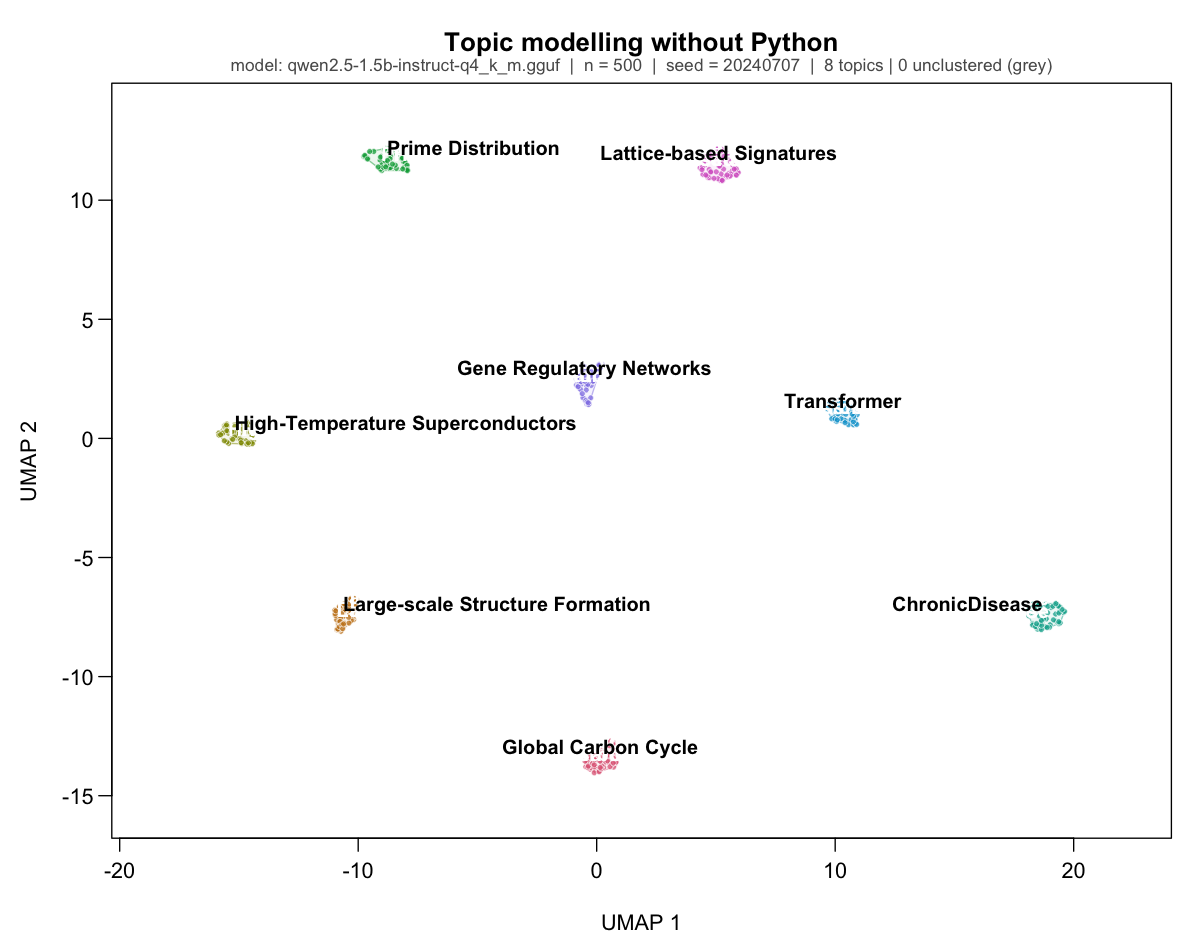
Recorded Demo B output on 500 abstracts. The figure illustrates this corpus and model run; it is not a general clustering-quality benchmark.
The repository includes two application templates, separate from the core API:
Their Mac/Linux operational acceptance includes interruption recovery and 1,000 same-worker service requests. Exact source provenance, limits and prior failures remain in the service report. Operational reliability does not establish extraction accuracy: the frozen D1 pilot had 10/10 schema-valid, 2/10 task-valid and 0/10 fully grounded records, failing all four promotion gates. See the quality evaluation.
The validation ledger distinguishes independent numerical references, regression checks and open hardware/research gates. The architecture and decisions explain the native engine and its boundaries.
Original code is MIT OR Apache-2.0. Vendored llama.cpp is MIT. Modified redistributions must rename under the trademark policy.
Start with the agent
guide, llms.txt
and the API/version
policy. The WP16 build includes sixteen independent R example
scripts under
system.file("examples", "agents", package = "relm").
Sourcing a script defines its example; it never downloads a model or
starts inference automatically.
The public API baseline includes the current exports and registered S3 methods. The project’s thirty-day green-CI gate precedes a future 1.0 release; CRAN admission and external-human usability are separate outcomes.